

Black Country
A memory of Donetsk

About two decades ago, I visited Donetsk with a Ukrainian friend. The month was August. Kuchma was the president of Ukraine, approaching the end of his second term. We arrived by train from Kharkiv, amid the dark waste heaps and familiar mining pit props.
Much seemed familiar, having been raised in an English town largely devoted to coal mining. And like the Yorkshire-Derbyshire coal miners, those of the Donbas, the largest coal mining area in Europe, had been among the first to go on strike in the late Soviet Union—a relatively successful one in terms of the gains—and continued in the post-Soviet period.
In the late 1980s, the miners had formed their own union, separate from the official trade unions so closely controlled by the Communist Party, and posing a direct challenge to the Soviet authorities.
The Donbas mines were dangerous and suffered from a lack of investment. They were very deep, and methane gas explosions were common. The accident rate was truly alarming, and all these problems only added to the strain of working underground and walking some six kilometres before reaching the coal face.
The city seemed almost entirely Russian-speaking. There was a high number of Roma people, especially children, around the railway and bus stations. But the mixture was derived from the rapid industrial development of the late 19th century. It was very different from the rest of Ukraine, but it was not Russian either.
In central Donetsk, we saw the statue of John Hughes, the Welsh entrepreneur who founded the city in the late 19th century after establishing a metal works factory there, as well as an Anglican church. The town, based on a Cossack settlement called Oleksandrivka, was originally named for him, Yuzovka, until Stalin’s official 50th birthday in 1929, when it was given the name Stalino. It became Donetsk in 1961.
Young people abounded, walking around the streets, girls sitting close to the statue of Lenin in the central square, wearing pointy shoes and heavy makeup. At one outlet, younger kids, mainly boys, were inside playing video games on screens all around the room.
The city was beginning to prosper, with new hotels and expensive restaurants. Several oligarchs seemed prepared to pour money into the new enterprises. The governor of Donetsk was Viktor Yanukovych, now in his fifth year. He would soon leave the position to become Prime Minister of Ukraine, and later, in 2010, the president.
The real power, however, was another native, Rinat Akhmetov, the coal miner’s son and an ethnic Volga Tatar, whose wealth reportedly derived from a company processing coke into coal, though he had been accused of criminal activities. He had begun to purchase property in the 1990s, in the early chaotic post-Soviet period.
Akhmetov inherited ownership of the Shakhtar Donetsk football club from his former business partner Akhmat Bragin, who was killed in a bomb attack in October 1995 at the Shakhtar stadium. All shady stuff!
We took a marshrutka to Horlivka, another large mining city that had been the centre of the breakaway union in the late 1980s. The tiny bus was so full that in order to pay the driver, and sitting on the back row, we had to find some change and pass it forward via the other passengers.
Horlivka was truly grim, with slag heaps all around. There was a statue near the centre of Nikita Izotov, which dates from 1968, and was one of the first statues to a simple coal miner. Or maybe not so simple, since he was acclaimed for his super-human record-breaking feats during the Stakhanovism years of the mid-1930s. There is another to the city’s founder Piotr Gorlov, the Russian engineer who founded the town and provided its name.
I spoke with one of the former union’s founders, and he informed me that eventually the militancy had been ended by the largesse of the mine owners, who had given the strike leaders cars and other gifts.
There was no sign then of any separatist sentiment in either Donetsk or Horlivka. Donetsk was full of flags, as the population prepared to celebrate the Day of the Coal Miner on the last Sunday of August. People sang old Soviet songs celebrating the heady days of the 1930s when industrialization was under way.
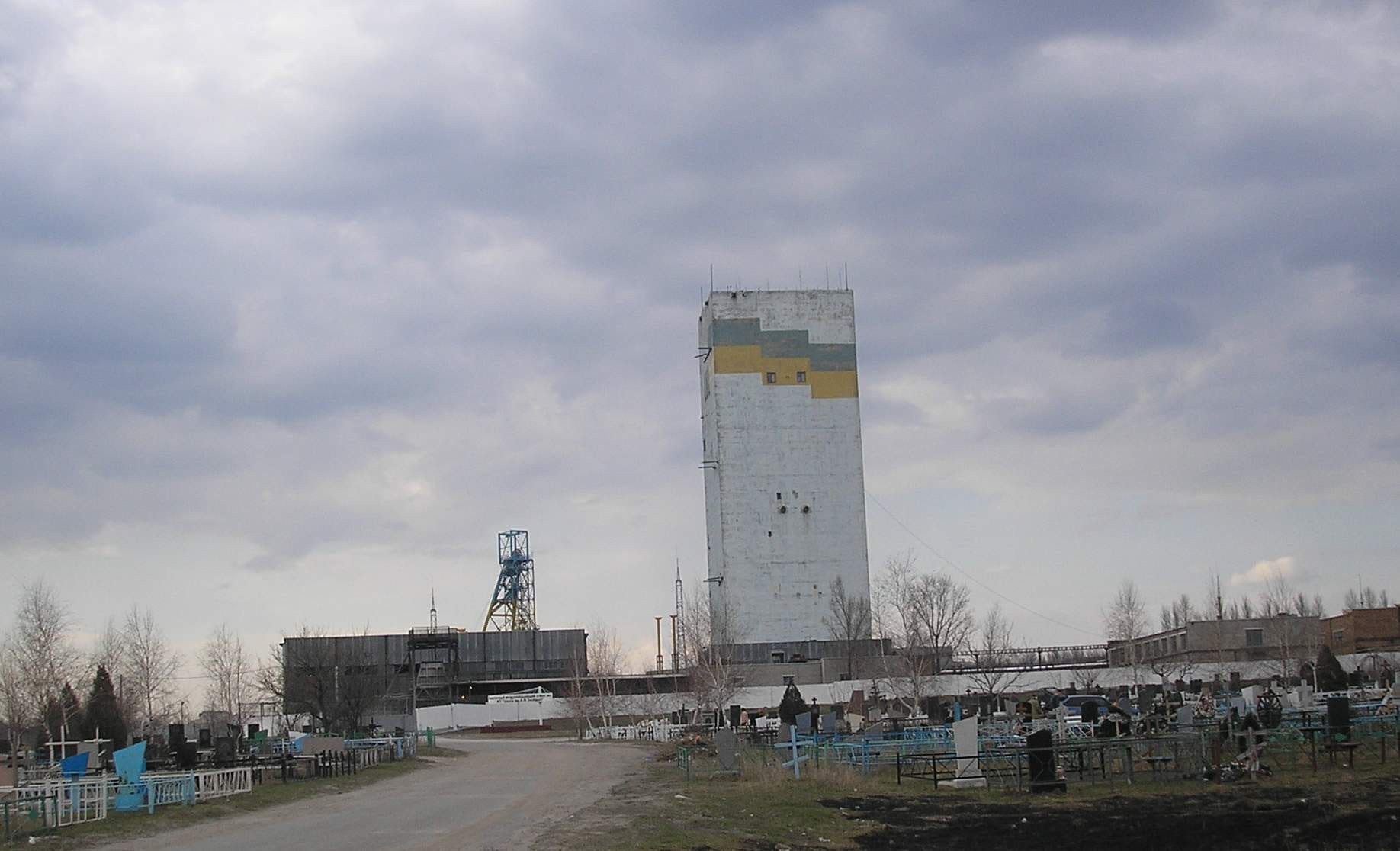
Zasyadko coal mine, Donetsk region (Wikipedia)
Just a decade or so later, things began to unravel for the citizens of Donetsk. Many were unprepared for the events of the Maidan in Kyiv, which toppled the presidency of Viktor Yanukovych and his Cabinet that had been filled largely with people from his home city.
Many of the Berkut police that were sent by Yanukovych into the streets of Kyiv to oppose the protesters came from Donetsk.
The eastern border became very active, and soon war started, prompted by pro-Russians, but also through Putin’s emissaries entering from Rostov to subvert the local governments. While the gunmen who set themselves up as leaders of the city and the so-called People’s Republic were locals, some outsiders held key positions.
The interim president of Ukraine, Oleksandr Turchynov, formed what was called an Anti-Terrorist Operation (ATO) to move east and retake the occupied cities.
The subsequent events are well known. After two vicious battles, which involved units of the Russian army, at Ilovaisk (September 2014) and Debaltseve (January 2015), both Donetsk and Horlivka became part of the so-called DNR, lost to Ukraine at least for the immediate future.
The new government in Kyiv, under Petro Poroshenko, initiated a trade embargo of the DNR, effectively abandoning the region that had been the heartland of Ukrainian industry. New leaders were appointed directly by Russia, though many did not last long and were either displaced or assassinated.
Notably, there was no mass migration to Europe or North America, as happened after the full-scale war initiated by Russia in February 2022. Displaced people either moved internally or—more frequently—migrated to Russia.
Russia’s role remained ambivalent. It had annexed Crimea but had not recognized the independence of the DNR and its smaller counterpart in Luhansk region. It had, however, kept them afloat with food, weapons, and some personnel, whom Vladimir Putin referred to as “volunteers.”
In February 2022, the Russian invasion largely solidified and annexed the two republics. In truth, Russia had distributed passports liberally to its population before that. Ukraine still contains important strongholds in the western Donetsk region, like Kramatorsk, but the capital city is out of reach.
Akhmetov remains in Donetsk, still rich, but less wealthy than before the war began. Donetsk, the city founded by a Welshman, is in the centre of a war zone. Horlivka, according to reports, has been largely destroyed in the fighting.
From Donetsk station, we took a late evening train to Simferopol, and then moved on to Yalta, another two cities no longer accessible to Ukrainians or western tourists.