

Dialogue or Isolation?
What policy should the exiled opposition and Western democracies adopt toward Belarus?

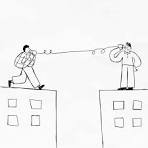
After her release and deportation from a Belarusian prison, the charismatic and influential political prisoner Maryia Kalesnikova, in an interview with the Financial Times, called on the EU to start a new dialogue with Belarusian dictator Aliaksandr Lukashenka. Her view is that isolating the Minsk regime will only push it ever closer into the arms of Russia.
Ryhor Astapania, the head of the Belarusian Initiative at Chatham House (UK), has also commented:
Through measures such as re-establishing contacts with the Lukashenka regime, restoring full diplomatic relations at the ambassadorial level, opening closed border crossings and transport routes, allowing Belarusian athletes to participate in international competitions, and lifting certain economic sanctions, the West could extract security concessions from Minsk and reduce repression. It would be a tangible success for Western policy.
The topic has been widely debated since at least 1999, and previous attempts to negotiate with the regime failed, usually because Lukashenka either reneged on the agreement or else treated dialogue as a means to exploit the state’s position between Russia and the EU for his own benefit.
Pavel Latushka, the former Minister of Culture, believes that such a stance would ensure the exclusion would cut the entire opposition out of negotiations.
Several years ago, Sviatlana Tsihanouskaya, the leader of the exiled United Transitional Cabinet, adopted the position that her office did not seek a dialogue with Lukashenka, but would appeal to those working in his government and that these contacts had already been established.
Would Lukashenka allow the release of all political prisoners, permit exiles to return to their homeland, and allow free and fair elections? Is it conceivable? In three decades of being in power, he has never come close to taking such steps.
The recent negotiations between the United States and Lukashenka led to the release of over 300 political prisoners in 2025, including Kalesnikava herself, and the other main rivals in the 2020 presidential election, Siarhei Tsikhanouski and Viktar Babaryka. But had sanctions not been imposed in the first place, would Donald Trump’s envoys have had any negotiating power?
Another argument is that constant pressure to release political prisoners from the exiles in Warsaw and Vilnius was equally important in securing the release of the prisoners.
But although the prisoners were released, the regime then targeted and arrested others. The numbers did not diminish, and the behaviour of the leadership did not change. There has not been even a slight easing of repressions.
Still, the question remains. What do sanctions achieve? And does the West want to see Belarus become little more than a puppet or vassal of Moscow, particularly the Moscow of Vladimir Putin and his aggressive Security Council? If the Lukashenka regime opens up to the West, if embassies are restored to their full capacity, and civil society permitted to revive, then surely this would be more beneficial than condemning the regime to a permanent status as an appendage of the new imperialist Russia?
Lukashenka has not forgotten 2020 and frequently talks about the exiles. Clearly, he fears for his future and seeks legitimacy. He has established his handpicked People’s Assembly as his new source of power, though he remains its chairman. He has allowed Russia to use his country as a tactical nuclear missile base and as a trial ground for Russia’s more lethal weapons, like the Oreshnik.
But he has also ordered the downing of Russian drones that cross into Belarusian territory. He has refused to send Belarusian troops into Ukraine. And he has leapt at any opportunity for contact, from welcoming the Trump envoys to joining the American president’s absurdist Peace Council, or serving as a mediator for warring factions in Russia (Putin’s generals vs Prigozhin).
Lukashenka is not someone who likes a straitjacket. While he has always valued power and its benefits, he is hardly a slavish and devoted follower of the Kremlin. He prefers some room to manoeuvre. Above all, like any dictator, he is seeking legitimacy, and over most of his period in office, it has largely avoided him.
Ending sanctions and restoring connections with Belarus thus has some logic. But if the EU takes that route, it needs to do so with a long-term goal of membership for both Ukraine and Belarus, which, after all, are central European states with long histories of separation from Russia. In this respect, the issue is not Lukashenka; it is what comes after him. In the long term, he is irrelevant.
More important is to ensure that the structures he has assembled, such as the People’s Assembly, can be quickly removed once his leadership ends, that parliament becomes effective again, and the rule of law is restored.
In the meantime, Russia is bombarding the people of Belarus with constant and relentless propaganda about the evils of the West, of NATO and the EU, and their roles in backing up the neo-Nazis in Ukraine. It is invariably the most absurd nonsense, but repeated endlessly, it gains a certain logic. Even Trump seems to be supporting the Kremlin’s positions on the EU and NATO, which provides some substance to Russian rhetoric.
There is thus a need to provide alternative viewpoints to the population of Belarus, and above all to restructure the education system, while ensuring restored primacy to the native language. All these potential developments depend on activities within the country, not outside it.
That is why the dialogue question persists, and perhaps it should. But the debate is only beginning.