

Why write about Belarus?

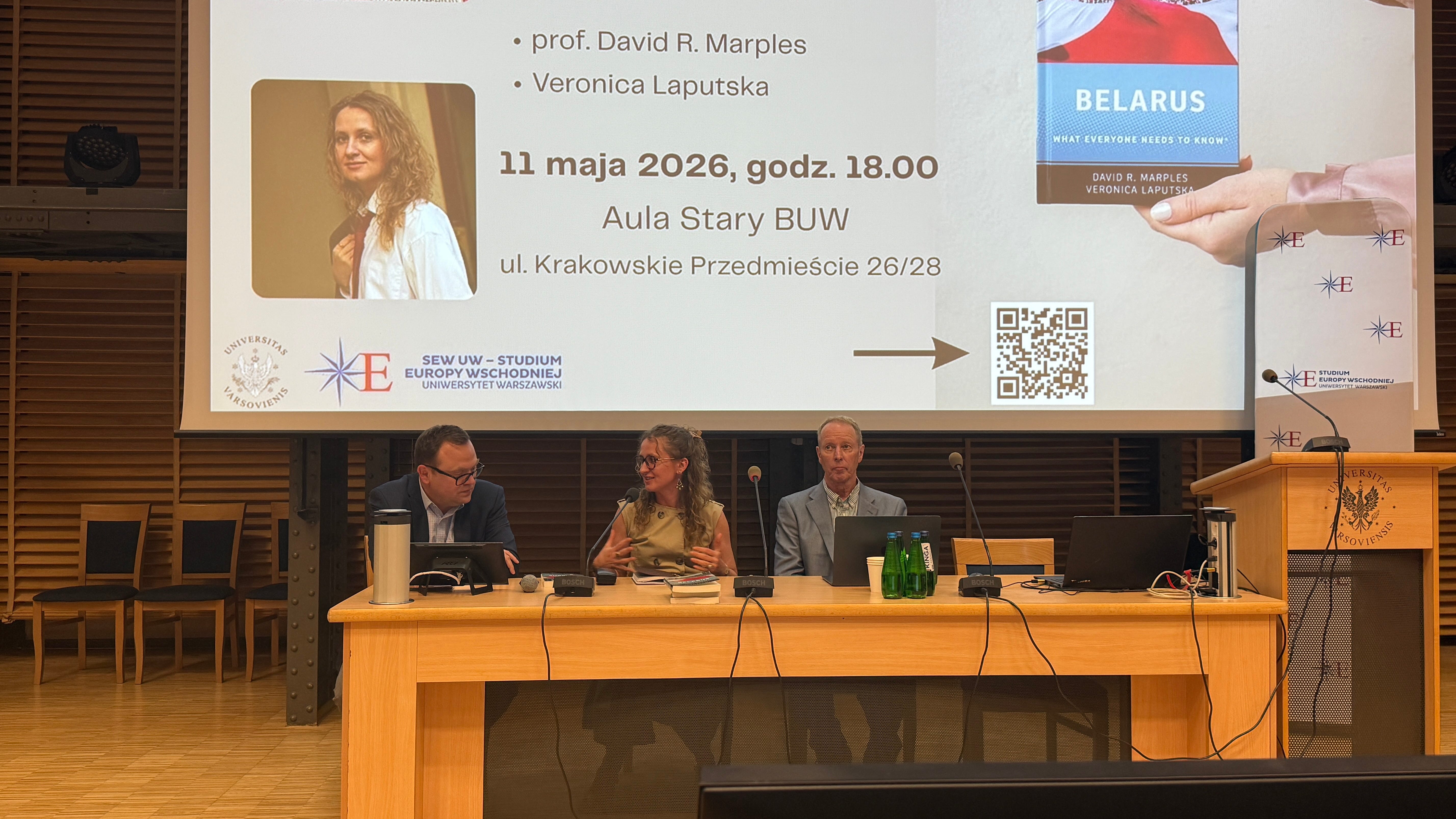
Belarus: What Everyone Needs to Know by David R. Marples and Veronica Laputska, Oxford University Press, 2026
Why write about Belarus? And why now, in the mid-2020s, as the world is engulfed in military conflicts, famines, and hostile rhetoric?
Belarus is not at war today, but it is nevertheless in a critical geostrategic position, as a close ally with Russia, with an aging dictator at the helm and struggling economically to deal with the effects of EU and UK sanctions.
The regime has been relatively isolated since 2020, as well as increasingly repressive, with no extant sources of civil life, no opposition political parties—in fact, very few political parties, period—no independent media, and seemingly a bleak future from the perspective of democratic development.
At the same time, the memories of 2020 remain as a signal that the desire for change existed and manifested itself for a brief period in mass demonstrations.
Let’s be frank. The opposition platform that emerged after the arrests and flight of the initial presidential candidates prepared to stand against Lukashenka was not ambitious. It called for the release of political prisoners and the holding of new elections to be monitored by international observers.
During the campaign, the theme was “change,” and the three women offered a refreshing platform that was neither pro-EU nor pro-Russia, simply about Belarus and its future.
The demonstrations protesting fabricated election results morphed into a broader phenomenon of national flags and symbols and of pro-EU sentiment. It encompassed all sectors of society, at least at its key points.
Many things have changed since 2020, but the most important is that Belarus became the launchpad for the Russian invasion of Ukraine.
The Russian invasion put Belarus at the forefront of a new European war. Today, with both sides losing troops at a catastrophic rate in a war of attrition, Russia has stepped up a campaign to integrate Belarus into its wartime structure.
A deeply amended Constitution has abandoned the country’s non-nuclear status, allowing Russia to install tactical nuclear weapons and Oreshnik missiles on Belarusian territory. Russia is exerting enormous pressure on Belarus to join the war against Ukraine.
Conversely, Ukraine is no longer neutral toward the Minsk regime, which it regards as hostile. It has abandoned its earlier stance, and its drones regularly cross Belarusian territory.
Belarus is seeking alternative sources of trade and alternative alliances, but none are really adequate. China is willing to trade, but not to invest significantly or interfere with Russian hegemony.
Familiar allies are no longer around. Iran is in a new war with the United States, the Assad regime in Syria has collapsed, and the Venezuelan ally has been removed from power.
Ironically, the United States has opened a new pathway for Lukashenka, offering removal of sanctions for the release of political prisoners, through a team headed by a real estate broker with no knowledge of the region and the president’s son-in-law.
Whatever the reasons behind these moves—and they are not new; they follow the initiatives of the Biden presidency that were interrupted by Covid—they have provided some security to the Lukashenka regime. Maybe that is the price one must pay for the release of prisoners, but it is a familiar political game for Lukashenka.
Yet there is much more to Belarus than the dictator or people around him, despite their monopoly of political and social life.
In our book, we have tried to show that Belarus is not an appendage of Russia but has its own history and can still develop into a central European state and away from the stifling control and propaganda of the Kremlin.
The legacy of the Grand Duchy of Lithuania, the 1918 declaration of independence, the horrors of the Stalinist 1930s, the Nazi occupation, the 1990 declaration of sovereignty and elevation of the national language, all show that the Republic of Belarus is not an anomaly or a Soviet invention as Putin claims.
Whether at various junctures Belarus has been pro-Russia or pro-EU, the overwhelming sentiment has been the preference for an independent state.
Dictatorships eventually fall, and the current ones in Moscow and Minsk are nearing the end, not least because of the age of the incumbent leaders. Vladimir Putin has embarked on a suicidal war that—if the objective is still to occupy Kyiv and change the Ukrainian leadership—is destined to fail.
Lukashenka has far more political sense than Putin, despite current dependency, but he has no vision other than the protection of personal power. In many respects, he belongs in the past, with Great Patriotic War nostalgia that can be hashed and rehashed so many times but ultimately becomes part of history rather than something to emulate.
What happens after the regime ends is dependent on the Belarusian people, including the tens of thousands in exile: professionals, diplomats, Hi-Tech and AI experts, cyber-partisans, and security officials.
The key question is whether there can be a return of the exiles or whether the creation of a new diaspora is something permanent. Either way, Belarus has a future.
This article appeared originally in Italian: https://www.lindro.eu/2026/05/12/cosa-ce-da-sapere-sulla-bielorussia/, 12 May 2026 (L’Indro, Turin, Italy)
@Darya Zorka